
Consumer Insight and Retail Market Analysis (Circana) recently released November sales data from the United States game market, prompting extensive industry discussion, but the industry ‘ s actual situation may be more critical than it appears. In November, United States hardware sales fell by 27 per cent in the same year, the lowest in 20 years; sales of software and services increased by only a small 1 per cent. While one-month data alone cannot be over-readable, the overall growth is still expected to be modest in 2025 (unless December is a disaster). But in November, the beginning of the traditional sales boom, usually the flashpoint of hardware sales and annual productions (Sport Year, Mission Call series, etc.), saw a full-line fall this year, which undoubtedly sounded a wake-up call for the industry.
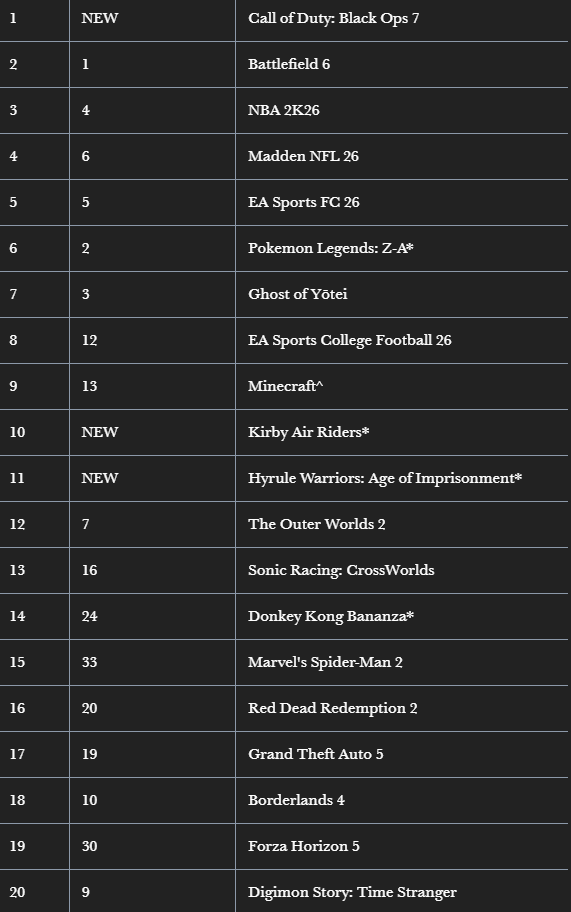
November game sales TOP 20
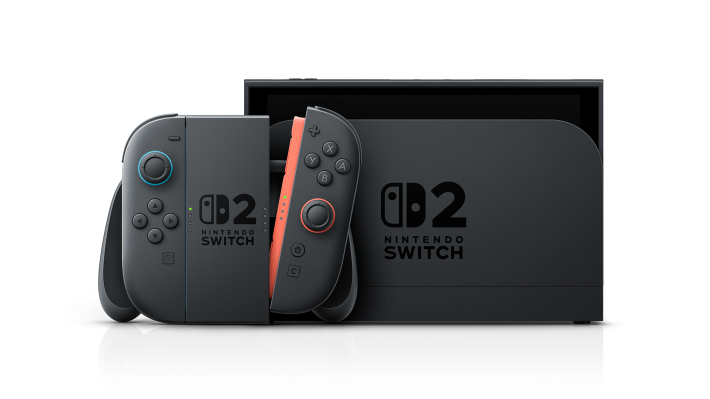
Hardware winter: new host failed to ignite the marketAll mainstream hosts on the market have experienced a year-on-year decline: Microsoft Xbox hardware has fallen the most, but most surprisingly, the Switch series of Nintendo (including Switch and Switch 2) combined sells less than the Switch singles sold in the same period last year. Switch 2 ‘ s first performance, although bright, did not lead to the expected strong growth of its first holiday season, revealing the core of the problem:Industry has touched the faults of mass consumption participation. LineI don’t know.
Fragments appear: the separation of core players from the general consumerHost start-up and day-to-day sales are supported by core players, while holiday season sales rely on more leisure, non-core consumer groups (e.g. parents who choose to buy gifts for their children, light players). In November, the data showed thatMass consumers in the U.S. market are alienating the game industry.I don’t know. They are not early warning signs of recession, and their loss itself is an important part of the recession. Core players may reduce their spending (particularly in the context of the soaring prices of PC spare parts), but games, as their hobby and passion, remain the fundamentals of the market. Mass consumers are different – game consumption is only one of many options, and if prices are inappropriate or unattractive, they may well switch to other alternatives (e.g. entry-level iPad prices are significantly lower than PS5 and Switch 2).

Rethinking: How does industry lose the mass market?
The problem is not pricing. Circana points out that in the last decade,The industry has largely abandoned its focus on children, families and leisure players, leading to the natural loss of these marketsI don’t know. Despite successful cases such as the AI-centred interactive home game system, Nex Playground, where demand still exists, industry has few products tailored to such groups, both in content and pricing. In the meantime,The collapse of entity retail has severely reduced the ability of the industry to reach out to mass consumersI don’t know. Core players are good at accessing and purchasing information online, but leisure players and parent groups rely on physical experience and visual contact. Circana, citing London as an example, is stunned by the loss of retail shops in Chen: non-professional retail stores have largely abandoned game shelves, specialized stores have shrunk to a very small number of houses, and the city centre cannot even find a host area for trial. When potential consumers are less information-sensitive and less participatory groups, net retailing is exposed during the holiday season.

The way forward: reconnecting with the mass marketNew products, new strategies and new channels of communication are needed to regain access to the mass market. This is undoubtedly more difficult than the continued exploitation of core player consumption potential, which has touched the ceiling in many subdivision markets. Industry competition cannot be limited to competing for the same core users — to survive this crisis that has already arisen, it must invest in new markets, develop products that can broaden the attractiveness of the media, and try to reach consumers who do not focus on the game media and the Red Ecology of the Net. Circana emphasizes that this may be the key to a new expansion jumpboard in 2026, rather than a narrative that perpetuates the slowdown and fears of recession. The industry’s “new year resolve” should perhaps be a new search for ways to reconnect with those who move away.
