
In response to rumours that the content of the player ‘ s work may be about to appear in the form of a paid random prop, Epic Gomes has expressly denied that Fortress Night will introduce gambling mechanisms. Previously, it was reported that the creators who used the Fort Night’s false editor (UEFN) would be able to integrate props that could be purchased through the game token V-Bucks.

According to leaks from industry sources such as ShiinaBR, which were reproduced by Insider Gaming, the system is highly similar to the traditional boxing mechanism: random props, probabilities, and regional restrictions in markets where boxing is prohibited. Belgium, for example, has, since 2018, explicitly prohibited the payment of random incentives, forcing companies such as EA and Snow to adjust or remove similar mechanisms. Epic responded to The Gamer that gambling “will not land at Fort Night” and that, according to the developer’s rules, the creator “shall not include gambling in its creative island”. However, the company recognizes that, where such systems are permitted, the developer may add a “pay random mechanism” if the proprietary is clearly labelled as a random item and the probabilities of pre-purchase publicity are specified.
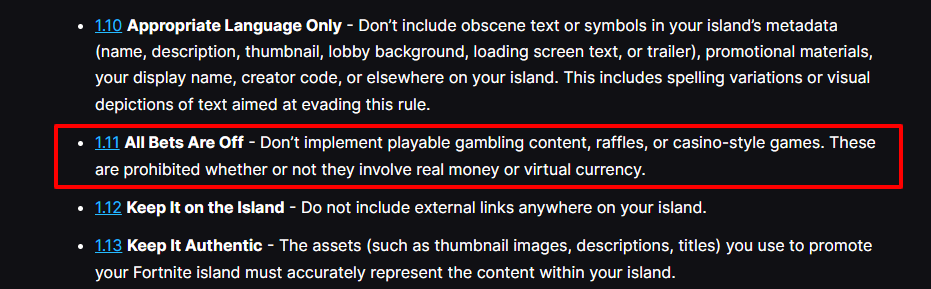
(Epic log regulations prohibit all forms of gambling content, lottery or casino games, whether real money or virtual money)
The definition of “gathering” and “paying random mechanisms” became key. The former would trigger regulatory review, while transparent random mechanisms remained in the legal grey area. By this definition, Epic positioned Fortress Night as a game similar to EA Sports FC, which continued to sell “the ultimate team” card packs, subject to the probability publicity rule. The controversy highlighted the continued sensitivity of the boxing mechanism. The mechanism was widely controversial in the late 2010s, and studies in 2022 confirmed that it caused economic and emotional damage to young players, prompting the EU to promote stricter regulation. The prospect of Epic introducing random incentives, even indirectly, rekindled these concerns. Epic ‘ s statement is both a denial and a commitment to compliance. Although gambling is explicitly prohibited, the release of “pay-for-random mechanisms” means that creators can sell random digital proprietors that use official currency transactions, subject to transparency requirements. For critics, this distinction may be just a word game.

The economic system of Fortress Night has long integrated gameplay and commercialization, both in connection with content and in user-created islands. The introduction of a commercialization random mechanism in the creator ‘ s content (even if subject to a probabilistic publicity system) marks a new phase in which the economic model of the game and the tolerance of the player will face the test. At present, Epic remains committed to excluding gambling from the options, and the final response of the player will depend on whether the actual way in which these random mechanisms operate is consistent with the company ‘ s commitments.
